Rocket Engine Nozzle Design Study — Engineering_▢✕
FileEditViewGoFavoritesHelp
UpAddress:
Drawing NZL-002 · Entry 02 · Jul 2024 – May 2025
Rocket Engine Nozzle Design Study
Propulsion · Independent Research
Complete
An independent research paper ("Optimizing Small-Scale Rocket Engine Performance") comparing three classic nozzle geometries — conical, bell, and aerospike — to find which best suits small-scale commercial engines, a corner of propulsion that's usually overlooked in favor of large orbital launchers.
The gap
- Most nozzle research targets large orbital engines; small-scale propulsion is comparatively unexplored and often just a scaled-down large design.
- That ignores the thermodynamic, fluid-dynamic, and geometric constraints that change at small scale — where nozzle geometry matters even more.
Method
- A physical test rig wasn't approved by the school research board, so I moved to a simulation-based approach for a controlled, repeatable environment.
- Built 3D CAD models of each geometry (throat and exit dimensions), then ran them in the HalfCat Simulator across consistent chamber conditions.
- Ran each configuration multiple times and normalized results to reduce run-to-run computational variance.
Findings
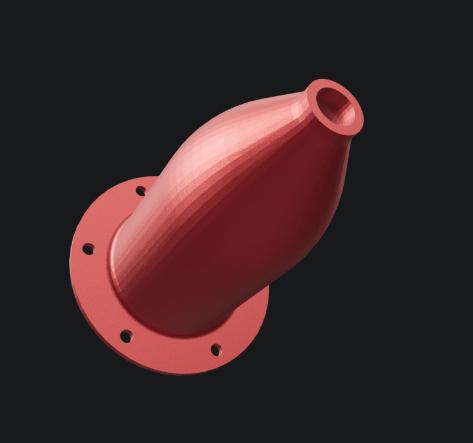
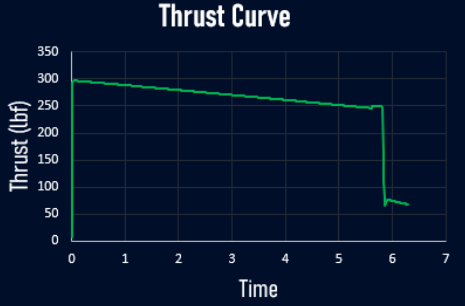
- The bell nozzle led on performance — 79% efficiency and 297 lbf peak thrust — thanks to better flow attachment and fuller gas expansion, but showed noticeable thrust oscillations early in the burn.
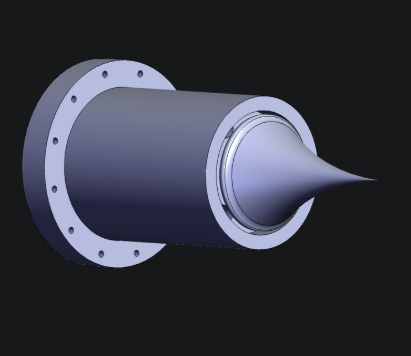
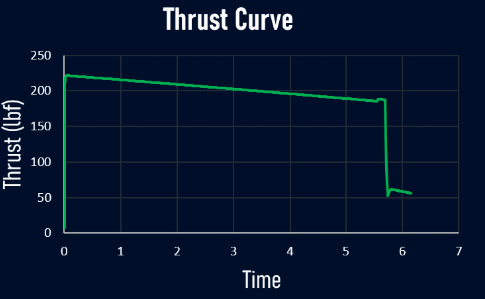
- The aerospike was the most stable (near-zero oscillation) at 60% efficiency and 221 lbf, but its manufacturing complexity works against commercial use.
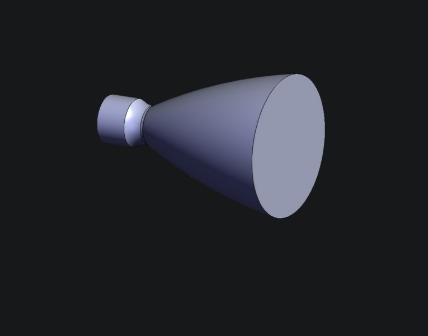
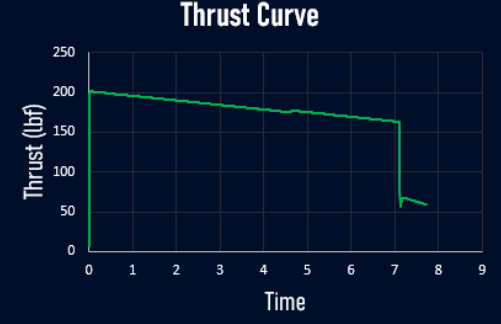
- The conical nozzle was steady and simple at 61% efficiency and 191 lbf.
- Specific impulse rose with expansion ratio only up to a point — an optimal band around 8:1–12:1 for small engines at atmospheric conditions, beyond which gains don't justify the added complexity.
Conclusion
- For most small-scale commercial applications — short-to-moderate burns where thrust matters — the bell nozzle is the best all-around choice: strong efficiency and thrust, and easy to manufacture.
- The broader takeaway: small engines should be designed for small-scale use from the start, weighing stability and manufacturability, not just chasing maximum theoretical performance.
Results
| Metric | Conical | Bell | Aerospike |
|---|---|---|---|
| Mass flow (kg/s) | 0.701 | 0.844 | 0.861 |
| Exit Mach | 0.60 | 0.95 | 0.81 |
| Exit temp (K) | 1600 | 1830 | 1740 |
| Exit velocity (m/s) | 230 | 325 | 275 |
| Efficiency | 61% | 79% | 60% |
| Peak thrust (lbf) | 191 | 297 | 221 |
Simulated performance by geometry (HalfCat)
Specifications
Geometries:Conical · Bell · Aerospike
Simulation:HalfCat Simulator + Fusion 360 CAD
Best overall:Bell — 79% eff., 297 lbf
Optimal expansion ratio:≈ 8:1 – 12:1
Paper length:~4,700 words
Type:Independent research
Tools:HalfCatSimFluid DynamicsThrust Modeling
Figures
Attachments
Full research paperOpen ↗
Complete write-up with literature review, method, and analysis (DOCX download).
Complete · Independent Researcher, scale Sub-scalePropulsion